
The Passing of Dave Morris
A PHOTOGRAPHER who spearheaded the developing role of news gathering in the navy in the 1960/70s, and who promoted news-worthy aspects of service life appearing on television and in national newspapers with award-winning photography, has died in Portsmouth aged 84.
Royal navy cameraman David Frank Morris BEM, passed away on Boxing Day, 26th of December 2023 in the city’s Queen Alexandra’s Hospital where he was being treated for both dementia and depression.
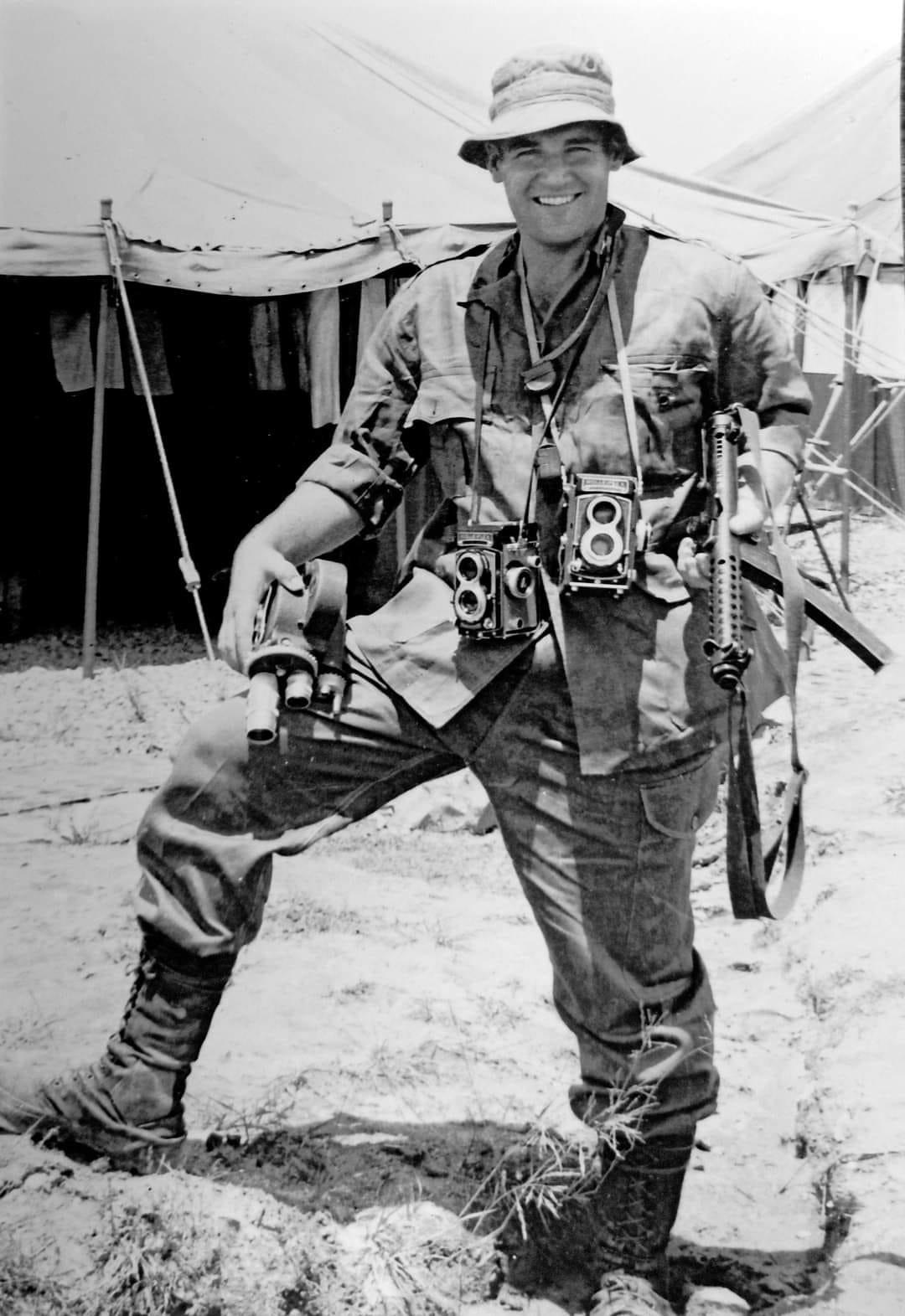
Always ‘Dave’ to his fellow phots, he was one of the most accomplished and creative members ever to serve in the photographic branch, and was awarded the BEM for his input into improving the curriculum of the navy PR course he once described as a ‘joke’. Born in the Dorset village of Charlton, Dave spent his formative years in nearby Ashmore and was educated at Shaftesbury Grammar School. His interest in photography started early, and while still a youngster he was earning pocket money by selling prints he produced of weddings, football teams and even local prize-winning cattle.
Dave considered several career choices including an apprenticeship as a royal navy artificer, but once he learned that photography was an option, he was determined to become a naval photographer. He joined the navy in 1956 aged 17, and went to HMS Gamecock, the Royal Naval Air Station (RNAS) near Nuneaton where he came top of his class in basic seamanship and airmanship. He was selected to train as a photographer. RNPA member Nigel Craft came second. The two men were then drafted to the Royal Naval School of Photography at HMS Peregrine, RNAS Ford near Arundel in Sussex to join No 25 Phot 11s Course, and they qualified as photographers under the tutelage of popular civilian instructor Jack Barber.
Coming top of the course meant Dave had the choice of where to begin his photographic career and, understandably, he picked the phot section at HMS Heron, RNAS Yeovilton in the west country. However, he finished up at nearby RAF Merryfield where an off-shoot phot section had been sited as Heron’s runways were being extended to meet NATO standards, the work being undertaken was generally thought to be so they could accommodate the USA’s B52 bombers. The section at Merryfield was a Nissan hut and was being run by petty officer ‘Pinhead’ Smalley. He left all the jobs to Dave who welcomed the experience gained.
An accident while riding his Ariel 350 NH motorbike left him with a badly fractured leg and four months’ recuperation in Taunton hospital. His next move was to Chatham to join HMS Vidal, the first in a new class of survey ships. After commissioning she crossed the Atlantic and headed for the West Indies, a dream destination for the crew. Dave was in his element as it allowed him to fly round the islands in the ship’s S51 Dragonfly helicopter taking rabbit shots with the twin-mounted F24 cameras. After a year in the West Indies and South America the Vidal limped back across the Atlantic at four knots, and taking 34 days due to engine problems and stopping to take water dips.
During his leave in August 1960 he married his fiancee Jean, and at the same time returned to RNAS Ford tasked with helping to close down the RN Photographic and Trials Unit (RNPTU). He then joined the Fleet Photographic Unit at Fraser Gunnery Range, Eastney, where he worked with cine guru Charlie Robinson who was producing an instructional film on the GMPG machine gun for the Royal Marines. Much to Dave’s delight the two men got the opportunity to fire the gun on the Hythe Ranges near Dover.
He was also involved in a series of HS300 trials on HMS Hermes on behalf of REA Bedford while the aircraft carrier was operating in the Mediterranean, working with Johnny Orme filming bolting Gannets at 300 FPS. The highlight of this period was a job shooting film and stills aboard HMS Ashanti, a new tribal class frigate – but which could have had serious consequences. Dave was booked for a helicopter ride but missed it as he was busy taking stills, and the Wasp chopper was lost.
He completed his Phot 1s at Whitecroft House, HMS Daedalus, Lee-on-Solent before heading to Singapore with wife Jean and their one year-old son Steve for a two-year married accompanied draft, working from the phot section at HMS Simbang. Almost immediately he was flying around Sarawak by helicopter taking photographs of military operations at Nanga Gaat, a forward operating base for British and Commonwealth troops during the Borneo Conflict, and chasing Indonesian kumpits (boats) while shooting cine-film for Movietone News.
Having initially returned to the FPU at Fraser Gunnery Range, Dave’s next draft was aboard the royal yacht HMS Britannia, where he spent two years photographing numerous VIPs and prominent world leaders who visited the ship.. Members of the royal family were regularly in his view-finder, including HM the Queen Mother. She sent him a much cherished acknowledgement after he had taken a portrait that she particularly liked and had used as that year’s Christmas card The ship also visited Expo 67 in Montreal, Canada, whilst completing a world cruise.
On his return to the UK Dave picked up his petty officer’s rate and a draft to DPRN in London for an introduction to naval public relations. He later described the course as ‘a joke’ but rectified the situation by helping to devise a more intensive and practical training programme which was subsequently used by all three UK armed services. He received his BEM at a ceremony held aboard Lord Nelson’s flag ship HMS Victory.
Dave was the last individual photographer to win the Peregrine Trophy – in 1968 – before the rules were changed to make it a competition open to sea-going ships and shore-based sections irrespective of size. With wife Jean in attendance he was presented with the trophy and a Rolleiflex camera by Admiral John Frewin.
With his heart set on being made a fleet chief petty officer he left the world of navy public relations to take over as regulating chief and senior instructor at the School of Photography based at HMS Excellent, Whale Island, but a P7R medical rating following earlier mental health problems meant this was not possible.
Dave’s naval career ended in 1977 when he was medically discharged. He immediately received job offers from several London-based national newspapers but decided on a new challenge as senior press photographer with the Portsmouth Evening News that lasted 20 years.
He enjoyed riding a variety motorbikes which, over the years, enabled him to travel over-night to the far reaches of Scotland’s north-west coast where he climbed or scrambled up a number of 3,000-ft high Munros. He also camped and took part in caving.
A skilled aero model maker, Dave built and flew a collection of impressive model aeroplanes, often enlisting messmates to help with the launch while he handled the control wires. When ever possible he took to the air with Roger Smith, his close navy friend of 55 years. Roger owned and flew several types of Cessna aircraft on photographic sorties for a number of companies. On one trip the two men found it amusing to be taking aerial pictures of RAF Cosford – home of the Joint Services School of Photography – where any one of the navy photographers present could have done the job. Roger, a former PO seaman and a keen photographer, was the proud recipient of Dave’s prize Rolleiflex camera – and was the last person to visit him before he died.
Fellow phots remember Dave as an enthusiastic individual who worked hard to capture the perfect picture, and who was always prepared to help and advise younger members making their way in branch.
He is survived by his son Steve, grandson Ben and grand-daughter Lucy. His wife Jean underwent a transplant operation after suffering kidney failure but died from cancer in 1998.
By Ray Pogson